Table Of Content
Imagine shipping a batch of expensive goods, only to have them arrive damaged, crushed, or rendered useless. It's a damage to your brand's reputation, not just a loss of merchandise, and no business owner wants to cope with that kind of catastrophe.
Corrugated packaging is the game changer! It combines toughness and unexpected flexibility owing to its layered paperboard construction. A structure that resists compression, absorbs shock, and even provides some moisture resistance is created by sandwiching a fluted (wavy) medium between flat linerboards. The outcome is reliable security for everything (from heavy machinery to delicate electronics).
It makes no sense to pay more when corrugated boxes are affordable and ensure high-quality printing to make a brand jump out on shelves. Moreover, they save shipping costs by being light and check the environmental box because they are recyclable.
In essence, it's lightweight toughness that has been designed.
This guide will surely help a beginner make wise choices, knowing about its structure and discovering its types, benefits, and styles.
Key Takeaways
- Corrugated packaging is an all-purpose, strong box for businesses interested in a reliable shipping tool.
- It promises better protection as the fluted structure gives a cushioning effect and creates strength without any additional weight.
- These are incredibly cost-saving, have the potential to be customized, and are environmentally sustainable.
- Single-wall to triple-wall, and the flute profiles of A, B, and C are the most commonly used types.
Understanding the Basics Of Corrugated Packaging
Packaging made of corrugated cardboard is not merely a box, but a man-made miracle that offers versatile real-world applications.
Corrugated packaging is more than just "cardboard," which is a commonly held misconception. In reality, three layers make up this structural material:
- A lining inside
- An external liner
- A fluted (wavy) medium sandwiched in between
That fluted layer? It increases toughness, endurance, and cushioning without adding bulk or weight. How? When two layers are glued together, they form air cavities that can be described as natural shock absorbers, which distribute a uniform amount of weight and shock.
Manufacturing of Corrugated Packaging
Production of a corrugated packaging with lid is a highly technical process. It starts with raw materials: the linerboard and medium paper (produced from either virgin fibers or recycled pulp) are rolled into massive reels.
Next comes the defining stage! The medium paper is subjected to heated corrugating rollers that cut the paper into flutes. Also known as signature waves, this structure is responsible for cushioning and rigidity. Then, the fluted sheet is glued to the linerboards by a paste known as starch adhesive in a high-speed machine called a corrugator. In the case of double-wall or triple-wall boards, multiple layers can be combined.
The board's structure is stabilized by carefully drying and cooling it once it is produced. After that, it is scored for accurate folding and slit to the necessary width. In order to create the final box shapes, the sheets are sliced into flat blanks.
Where necessary, printing is done through flexography to create colorful designs.
Types Of Corrugated Packaging
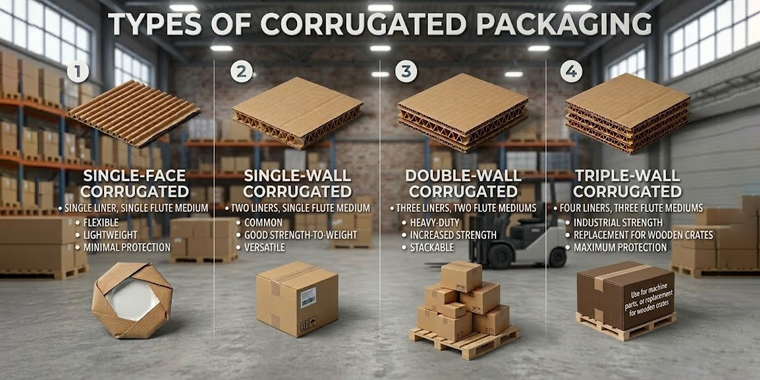
The analysis of the various corrugated mailer boxes will provide an opportunity to identify the packaging that meets the extensive needs. It comes in different wall types, depending on how much strength you need. Here’s a quick breakdown:
Single-Face Corrugated
This simple variant has a single fluted layer attached to a single linerboard. Further, this soft and flexible board is commonly used for wrapping or as padding in boxes, which offers cushioning without being bulky. Being easy to roll, it is ideal for delicate products such as glassware.
Single-Wall Corrugated
The most popular type is single-wall, where the fluted medium is positioned between two linerboards. It is lightweight yet strong enough to be used in the daily shipment of apparel, cosmetics, or retail goods. Imagine it as your staple of medium-weight products!
Double-Wall Corrugated
Two-wall is best used for heavier loads. Why? Because it features an additional medium and another liner to make a final construction of two layers of fluting with three liners. This increases the stacking power as well as puncture resistance, which is ideal for long-distance shipping of industrial items or stacked displays.
Triple-Wall Corrugated
The triple-wall is a heavyweight champion comprising three layers of fluting and four liners. It is as strong as wooden crates, but it is much lighter. That is why it is utilized in bulk shipping of high-value equipment.
What Are The Corrugated Flute Profiles?
The wave size and shape are determined by corrugated flute profiles that ultimately affect cushioning and the quality of print. Bigger flutes are perfect for delivering larger or more delicate objects since they provide more padding and stacking strength. Smaller flutes, on the other hand, produce a flatter, more polished surface that is excellent for retail-ready packaging and crisp, superior printing.
Each of the A through F categories of flutes has a distinct thickness and quantity of flutes per foot. A-flute, for example, is the thickest and is made to provide the most resilience and padding during transit. F-flute, on the other hand, is extremely thin and frequently used for small retail boxes where aesthetics are just as important as security.
Read More: Corrugated Flutes: Sizes, Types, Thickness & How to Choose the Right One
Not all flutes are created equal! To visualize, here's a table comparing common profiles:
|
Flute Profile |
Thickness (Approx) |
Flutes per foot | Best For | Key Advantages |
| A-Flute | 5 mm (1/4 inch) | 33 | Fragile, heavy items | Superior cushioning, vertical strength |
| B-Flute | 3 mm (1/8 inch) | 47 | Canned goods, inner packing | Good printing surface, puncture resistance |
| C-Flute | 4 mm (5/32 inch) | 39 | Shipping Cartons | Versatile, Balances strength and cushioning |
| E-Flute | 1.5mm(1/16 inches) | 90 | Retail boxes | Excellent printability, slim profile |
| F-Flute | 1mm (1/32 inch) | 125 | Small Packaging | High-density space saving |
Pro tip: To achieve the best of strength and printability, manufacturers occasionally blend several types of flutes, such as the BC flute.
Benefits Of Corrugated Packaging (Why Everyone Uses It)
Besides being noted to be practical and efficient, corrugated mailers have a glut of outstanding advantages:
Superior Protection:
Fluted design protects packaged contents against impacts, vibration, and compression.
Light but Sturdy:
It reduces transportation expenses as it is lightweight and sturdy, unlike heavy models.
Economical:
The low costs of production and recyclability reduce the total expenses incurred by the businesses.
Customizable:
It can be printed with logos (especially finer flutes like E or F) or cut into any shape to be used for various types of products.
Eco-Friendly:
It is made of renewable materials and can be recycled, which helps in sustaining the environment.
Multipurpose:
Corrugated boxes can be used in retail shelf displays, industry shipping, and all types in between.
Typical Box Ideas of Corrugated Packaging
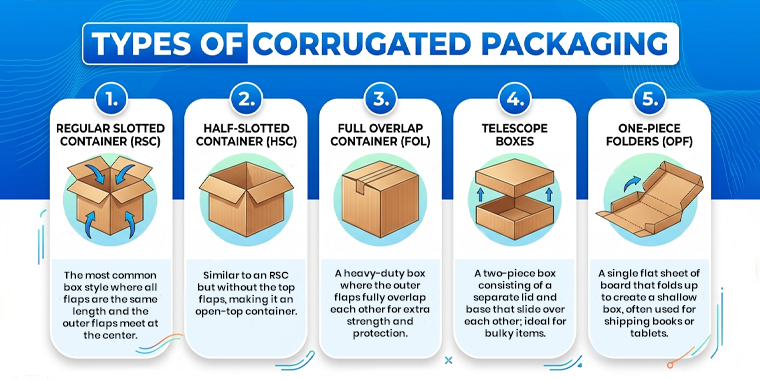
No, these are not brown, bland shipping boxes. Yes, there’s a whole lineup of styles for black to colored to white corrugated packaging for different uses:
Regular Slotted Container (RSC):
This is THE classic type of boxes with the flaps that meet in the center and can be easily taped; it is used in general shipping. Moreover, it is considered useful for long-term storage and efficient logistics.
Half-Slotted Container (HSC):
This is similar to RSC except that it opens at one end, which is suitable if you seek quick, effortless loading as well as a user-friendly display.
Full Overlap Slotted Container (FOL):
Flaps are completely overlapped to enhance bottom strength. This is how it is rendered appropriate for heavy or fragile items needing added protection.
Telescope Boxes:
These are two-piece boxes in which the lid slides over the base; ideal where various heights are required and need extra coverage.
One-Piece Folders (OPF):
Folds are made of single sheets, ensuring a specific wrap-around design for flat items. Furthermore, it is frequently used for books, frames, or apparel.
Go For The “Smart Packaging”
The problem is that corrugated boxes are now used for reasons other than protection. These days, brands use kraft corrugated boxes to communicate their message directly on the box, include smart features, add QR codes, and create remarkable wrapping.
Additionally, corrugated is emerging as a responsible option that doesn't sacrifice performance as environmental practices gain traction.
Summary
Although corrugated packaging doesn't immediately draw attention, it does deserve appreciation. After all, it is made to be strong, flexible, and able to adjust to the demands of contemporary packaging. In fact, it is a trusted companion in terms of protection, efficiency, and sustainability.
Custom Design Boxes provides the finest corrugated packaging within budget that provides protection to your products and builds your brand. As experienced people, we are quality and customized. Now, call us at 888-385-1812 and talk about your needs and receive a quote.

Abdul Waheed
With over a decade of experience in the printing and packaging industry, I’ve dedicated my career to helping brands reshape their identity with creative, sustainable, and cost-effective packaging solutions. Being the CEO of Custom Designs Boxes, my mission is simple: to balance innovation with affordability so businesses of every scale can enjoy premium packaging truly reflecting their vision. When I’m not strategizing for the next big packaging trend, you’ll find me exploring design inspirations, mentoring my team, and building lasting relationships with clients.