Table Of Content
If you own a packaging business, manage a brand, or have just an interest in printing, then you must know all about paper coating. It's the last layer that makes normal prints look clearer, richer, professional, and crisp while making them more resistant and long-lasting.
Today's brands require smooth packaging that looks good and withstands harsh handling, and is yet eco-friendly. Aqueous coating comes into focus at this point! This water-based finish has emerged as one of the most reliable coating choices in contemporary printing.
Everything you need to know about aqueous coating is explained in an easy-to-read, interesting, and informative manner in this guide. It explains what aqueous coating really is, how it functions, and why the proper finish can make or break your printed materials.
What is Aqueous Coating?
Aqueous coating is a clear, fast-drying, water-based protective layer applied to printed custom boxes. "Aqueous" simply indicates "based on water." Aqueous coatings are safer and more ecologically friendly (emit fewer VOCs) than solvent-heavy finishes since they rely on water as the main carrier. Surprisingly, it is one of the most cost-effective finishes available for commercial printing today.
It is applied to the freshly printed ink layer by a roller. Then, the coating is fast-dried by heat or air, which creates a smooth, protective film. Besides improving sturdiness, resilience, color vibrancy, and surface feel, it protects printed designs from:
- Prevents ink smearing
- Fingerprints
- Dust (daily wear and tear)
- Moisture damage
- Scuffs and scratches
- Darkening and fading
Common Uses
You can commonly find it on:
- Folding cartons
- Cosmetic boxes
- Brochures
- Business cards
- Book covers
- Product labels
- Food packaging
Coating Process
For large-scale production, the aqueous coating printing technique is very effective because it takes place immediately on the printing press.
This is how it works:
- Paperboard is used to print artwork.
- A uniform coating made of water is applied.
- The coating is rapidly dried using heated air systems.
- Sheets enter the finishing steps right away.
Aqueous coating is perfect for high-volume commercial printing operations where speed is crucial since drying occurs quickly. Additionally, its performance helps brands shorten turnaround times without compromising the quality of their presentation.
Why Aqueous Coating Paper Matters
Not all papers respond to coatings in the same manner.
The term "aqueous coating paper" describes paper stocks made especially to effectively absorb and retain water-based coatings. The surface of the paper influences:
- Drying rate
- Level of shine
- Smoothness
- Adhesion of ink
- The final texture
Coated paper often offers the finest visual effects because it allows the coating to lie uniformly on the surface instead of soaking deep into the fibers. Well, this can still be applied to uncoated paper, although the result is often softer and less reflective.
Types of Aqueous Coating

Not all aqueous coatings look the same. Different finishes create different visual personalities for packaging.
1. Glossy Aqueous Coating
The most common commercial printing coating is glossy. It serves as a reflective layer that creates a shiny effect and enriches the colors on the surface. Apart from making colors appear brighter, it ensures that each detail of the design looks sharper, giving boxes a retail-ready look.
Best for:
- Retail packaging
- Catalogs, photo books, etc.
- Brochures, flyers, menu, etc.
- Die cut packaging for products
- Magazine covers
2. Matte Aqueous Coating
Matte aqueous coating is just the reverse! It diffuses light instead of reflecting it, and has a beautiful and soft texture. Yes, it doesn't pop the patterns aggressively under store lighting. Matte is often the choice of designers for high-end brands as it adds the element of decency and grace. Undoubtedly, it has become widely popular for a packaging to get a clean, modern aesthetic.
Best for:
- Luxury brand packaging
- Business cards
- Stationery
- Beverage boxes
- Book covers
3. Satin/Soft-Touch Aqueous Coating
Need a shine but without excessive reflection? This is it, a medium glossy finish that feels refined and versatile. A well-rounded, tactile look is guaranteed, which many brands adore for its texture and warmth. Anyone can love it for its classy “soft glow” effect.
Best for:
- Boutique packaging
- Product catalogs
- Rigid Gift boxes
- Gourmet chocolate bar packaging
What Is the 80/20 Rule for Coating?
In general, the 80/20 rule for coating relates to optimizing coating performance through effective material utilization. To put it simply:
- Appropriate surface preparation and application techniques often account for 80% of coating efficiency.
- Just 20% is dependent on overly thick layering.
Protection is not usually enhanced by overapplying coating. Compared to excessive application, a smart application produces better results.
Are you wondering What Is the 90/10 Rule for Coating is? It implies that environmental control, equipment calibration, and preparation account for 90% of coating performance. Just 10% is dependent on the actual coating substance. Lastly, inadequate application circumstances can cause even high-end coatings to fail.
Aqueous Coating vs UV Coating: The Key Differences
In the debate of aqueous coating vs UV coating, take into account that aqueous coating is the better choice in terms of flexibility, cost, and environmental impact. The durability and the level of brightness of the gloss are the cards UV wins.
A complete comparison of aqueous coating vs UV coating is given below:
| Feature | Aqueous Coating | UV Coating |
| Drying Method | Air/heat dried | Cured instantly with ultraviolet light |
| Finish Options | Gloss, matte, satin | Gloss (primarily) |
| Durability | Good — resistant to scuffs, moisture | Excellent — very hard, highly durable |
| Environmental Impact | Low VOCs, eco-friendly | Higher VOCs, less eco-friendly |
| Cost | More affordable | More expensive |
| Drying/Curing Speed | Fast | Near-instant |
| Printability After Coating | Can be written on or foil-stamped | Difficult to overprint |
| Flexibility | Yes — suitable for folding | Can crack on folds |
| Application | In line with the press | Requires a separate UV unit |
| Best For | Brochures, packaging, books | High-end luxury items, business cards, and tags |
Read More: Spot UV: Explaining the Process, Applications, and Benefits
Applications of Aqueous Coating
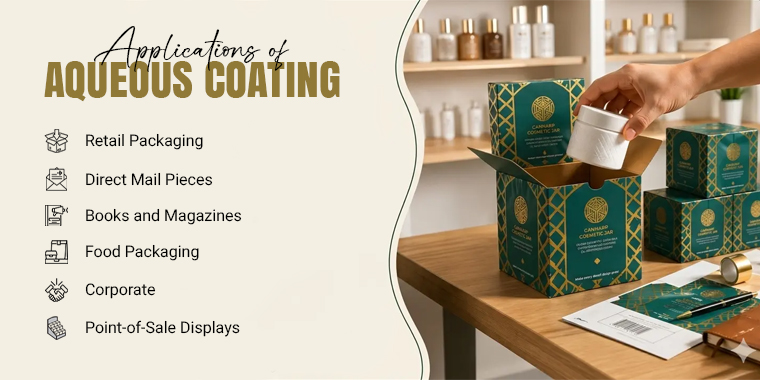
You'll experience aqueous-coated products every day, without realizing it. Here are some of the more popular uses:
Retail Packaging
From cereal boxes and cosmetics packaging to software and food packaging, retail product packaging relies on aqueous coating to maintain the freshness of its glittering colors and refreshing designs amid daily wear and tear in stores.
Direct Mail Pieces
Machines, hands, and weather carry a direct impact on postcards, mailers, and flyers. Every piece is protected by a coating, which means that your message reaches your audience looking clean, professional, and as you envisioned.
Books and Magazines
Aqueous coating provides a polished, durable appearance that will not fade or scuff from repeated handling, stacking in bookstores, or shipping.
Food Packaging
Moisture, grease, and constant contact are the challenges for Food Packaging, Takeaway boxes, and drink carriers. Aqueous coating will provide a barrier to protect the packaging, maintain hygiene, and look appealing all the way through the customer journey.
Corporate Stationery Boxes
Your brand is present in all your meetings in the form of Business Stationery, Letterheads, and presentational folders. AQ coating provides a polished and professional appearance, is fingerprint and smudge-proof, and every first impression is a good one.
Point-of-Sale Displays
Counter cards and Shelf Talkers are new in the traffic. These displays will keep your promotional message fresh and compelling longer because they are protected from repeated touching, spills, and light exposure.
Why Aqueous Coating Matters in Modern Printing
The printing industry is rapidly changing. Brands should be packaged and printed in a way that will catch a consumer's eye, withstand shipping, and communicate quality. Aqueous coating is effective in meeting all three requirements.
Fact: According to a report from Smithers, the global printing inks and coatings industry will more than double in value to exceed $28 billion by 2029, with water-based coatings representing one of the fastest-growing areas driven by growing demands for sustainability.
- Protection: The lifespan of any printed piece is extended manyfold with the help of a water-based layer.
- Quicker Turnaround: Aqueous coating will dry fast, contributing to the faster production cycle of e-commerce packaging. No waiting and eliminating additional drying steps. Clean, ready to print, prints rolling off the press.
- Eco-Conscious Printing: The need for eco-conscious printing businesses today is increasing. Compared to the solvent-based coating process, water-based aqueous coatings have a much lower content of harmful chemicals.
- Versatile applications: From food-safe to luxury retail boxes, aqueous coating is suitable for almost all boxes. One of the most versatile finishes, it will bond well to coated or uncoated stocks.
What Is the ISO Standard for Coatings?
International quality criteria known as ISO standards contribute to ensuring coating quality, stability, uniformity, and longevity. Manufacturers frequently adhere to the following guidelines when it comes to packaging and printing:
- Testing for adhesion
- Resistance to abrasion
- Safety of the environment
- Sensitivity to chemicals
- Consistency in print quality
Depending on the product category and industry necessities, different coating applications can use distinct ISO specifications. Throughout big packaging runs, these guidelines support brands in maintaining consistent production quality.
Conclusion
Although aqueous coating appears like a small technical detail, it can make a big difference in the look, feel, and durability of your printed materials. With first impressions made in seconds, the choice of paper coating can make all the difference between a product being picked up and left on the shelf.
This finishing technique offers both beauty and practicality, regardless of your preference for the velvety richness of soft touch coating printing, the retail sheen of gloss aqueous coating, or the clean modernity of matte aqueous coating. If you need custom boxes with the best quality finishing, contact Custom Designs Boxes at +1(888)-511-0592.
Frequently Asked Questions
We’re confident that you will love our products and service.

Abdul Waheed
With over a decade of experience in the printing and packaging industry, I’ve dedicated my career to helping brands reshape their identity with creative, sustainable, and cost-effective packaging solutions. Being the CEO of Custom Designs Boxes, my mission is simple: to balance innovation with affordability so businesses of every scale can enjoy premium packaging truly reflecting their vision. When I’m not strategizing for the next big packaging trend, you’ll find me exploring design inspirations, mentoring my team, and building lasting relationships with clients.