Table Of Content
No more just boxes; packaging is your first interaction with your customer now. So today, the pivotal printing method in that change is CMYK color printers. As a growing D2C brand, cosmetics manufacturer, or big food producer, it is essential to grasp these changes to remain competitive. Your packaging choices today will help you create your presence on the shelf tomorrow.
The packaging printing industry has come a long way from the days of bold photorealistic designs to sustainable short-run printing, as the world has become more creative. Brands that used to depend on the premium spot-color plates are looking to achieve sharper print results, quick turnaround, and reduce costs by opting for CMYK printing services.
Keep reading to find out how this colour revolution is playing out, and how your brand can help to lead it.
What is CMYK Printing?
Let's take a moment before exploring the trends and see what the key question is that needs to be answered:
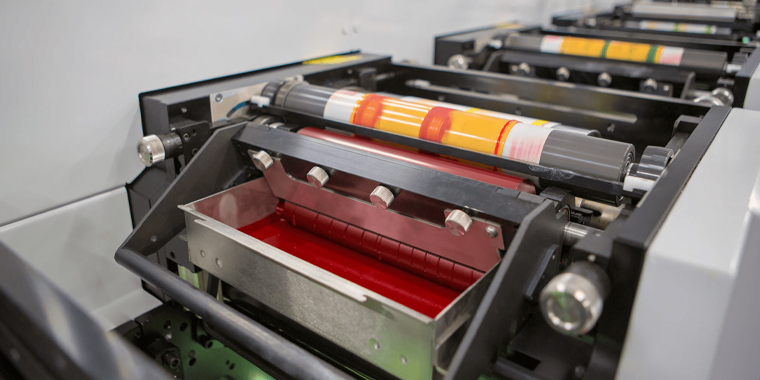
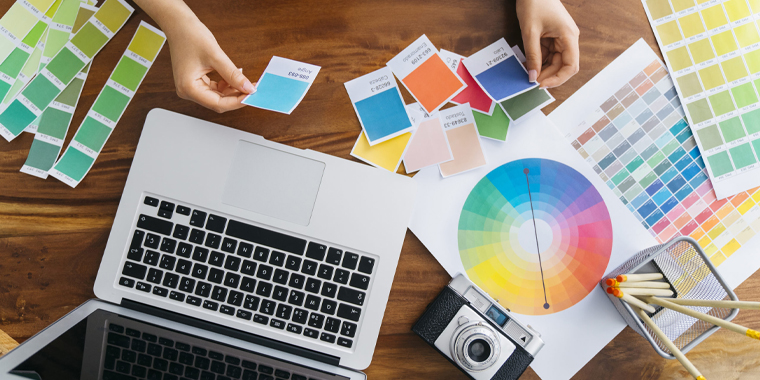
CMYK is the term for Cyan, Magenta, Yellow, and Key (Black). The four inks, when applied in different proportions, can create virtually an infinite number of colors when printed. CMYK printer ink (as opposed to screen displays, which add light) subtracts light wavelengths from white paper. This provides rich, accurate, and print-ready colour for e-commerce packaging.
This is quite unlike RGB printing (Red, Green, Blue). It is an additive colour system used for digital displays. Yes, it produces colors by emitting light.
RGB or CMYK for print? The answer is always CMYK because digital devices use RGB light combinations to display colors.
Read More: How to Ensure Consistent Colors When Converting RGB to CMYK
How CMYK Printing Is Reshaping Packaging Trends
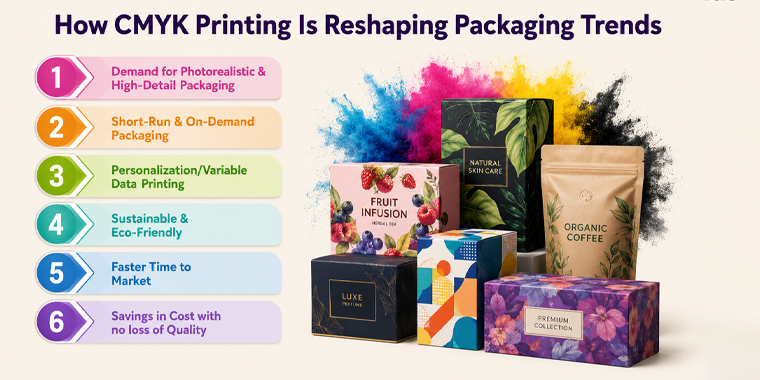
The packaging sector is going through a major transformation. CMYK was not simply a printing technique; it's the marketing core of today's brand packaging.
1. Demand for Photorealistic & High-Detail Packaging
At the supermarket checkout, consumers decide to buy products in less than 7 seconds. That means the impact of the image is all-important!
Breathtaking photorealistic imagery can be achieved on all packaging surfaces with the CMYK color printing system, whether it's corrugated shipping boxes, flexible pouches, or labels. Moreover, modern CMYK digital presses provide smooth color transitions, micro-detail, and consistent hues and colors for thousands of units of printing, as opposed to older printing technologies, which had difficulty with gradients and photos.
This can be particularly effective for:
- Food packaging that demands a vivid palette with high-resolution typography, photo, logo, and more.
- Cosmetic boxes with skin tone-matched model images.
- Fine writing and a gradient background for retail packaging.
- Premium gift boxes.
2. Short-Run & On-Demand Packaging
The traditional offset printing used to be expensive and had a minimum quantity of thousands of pieces for each order. That era is over!
Today, short-run printing and packaging are not only feasible but even a sound business decision with digital CMYK printing services. Even small and mid-sized brands can take a toll-free advantage of printing, as few as 50 or 100 units. This gives them an agility normally found in Fortune 500 companies.
Some of the top benefits for SMBs and D2C brands are:
- No plate costs: Digital CMYK means that there is no plate-making step required to create the printing plate(s).
- Bespoke nature: They are designed and created specifically for the client.
- Faster turnaround: Orders are shipped within days, not weeks.
- Inventory control: Print as needed, when needed;
- Market testing: Test various designs at the same time to see how they are received in the market
The global digital printing packaging market reached USD 24.0 billion in 2024, and is expected to grow to USD 42.2 billion by 2033 at a CAGR of 6.14%. (Source: IMARC group)
3. Personalization/Variable Data Printing
Modern-day consumers crave to be seen. Personalised packaging does just that!
CMYK colour printing technology works perfectly with variable data printing (VDP). Each box, label, or pouch can be different, without impacting the press speed or costs. This can present some great opportunities:
- Holiday packaging – festive editions, summer specials
- The images and language influenced by geography (regional variants)
- Unique partnerships with artists or influencers for limited editions.
- Name/Message on direct-mail packaging – personal name or message on the front of the mail piece.
Consumers are more engaged with personalized packaging, showing up to 40% higher engagement than with standard packaging. All this is made possible by using CMYK, and without the price tag that traditional printing has!
4. Sustainable & Eco-Friendly
“Sustainability” is no longer a passing fancy, but rather a business necessity.
Today's CMYK printer ink comes in various types, such as water-based, UV-curable, and soy-based, which significantly decrease VOC emissions. With traditional spot colour printing, plate wash chemicals are required, which adds to the amount of waste.
CMYK digital printing generates a lot less waste as opposed to traditional spot colour setups, which include CMYK systems and plate wash chemicals.
In the world of sustainable brands, the move to sustainable CMYK printing is not only a mark of environmental responsibility, but it's a wise business move.
5. Faster Time to Market
The first brand to respond will get the shelf!
Traditional offset printing involves making plates, which extend print production days or even weeks. Digital CMYK is when a design file is printed from the screen on custom boxes with logo.
| Feature | CMYK Printing | Traditional Spot Color | RGB (Screen Only) |
| Color Range | Wide gamut, photorealistic | Limited to defined inks | Widest — screen use only |
| Print-Ready? | Yes — industry standard | Yes — fixed colors | No — must convert first |
| Short-Run Friendly? | Highly cost-effective | Expensive for small runs | N/A |
| Ideal For | Packaging, labels, boxes, brand logos | single-color | Digital screens only |
| Sustainability | Water-based ink options | More ink waste | N/A |
This quickness is a game-changer for product launches, promotional campaigns, and when it comes to reactive seasonal packaging.
6. Savings in Cost with no loss of Quality
Spot colours or traditional printing means that if you want to use a different colour for a letterhead, it will be an extra cost as you need to set up inks and plates for each colour you use. A press set up charge for a 6-color packaging job might be 6 separate plates!
This can be combined into four standard inks – called CMYK colour printing. Today's wider range of CMYK gamut technology means that printers can achieve 90-95 color matching of Pantone colors in the CMYK printing process without the need to use spot plates. The result? High quality at a drastically reduced cost/unit.
In addition, a CMYK test print run prior to final print will enable brands to make colour adjustments without wasting full run materials to ensure that colour is accurate.
Industries Leading the CMYK Packaging Shift
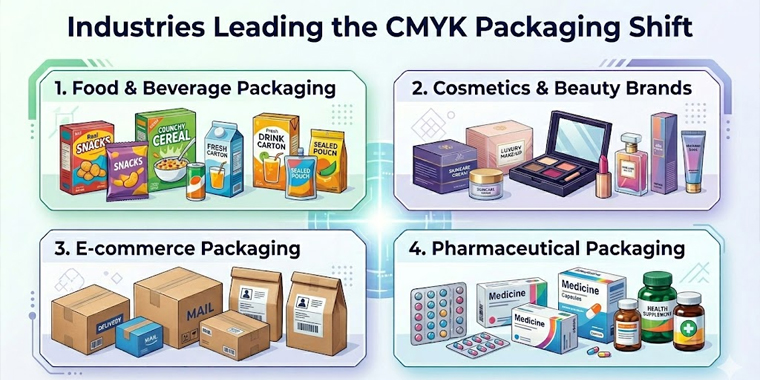
CMYK printing is the industry standard for producing accurate and vibrant printed packaging. Here are the top industries relying on CMYK:
Food & Beverage Packaging
New CMYK colour printing is changing the face of food banks. With CMYK, photorealistic photos of fresh ingredients, colorful stories, and compliance with the regulatory labels can all be printed seamlessly. Besides, short runs are a good option for brands to test packaging before ordering it on a large scale.
Lastly, CMYK's water-based ink solutions are FDA-approved for food contact applications — a significant benefit for food packaging applications.
Cosmetics & Beauty Brands
Beauty packaging is an image talk. Details like skin tones, shimmer effects, and the gradient backgrounds are the things that set the CMYK screen printing and digital CMYK apart.
Luckily, short-run is a major advantage for indie beauty labels that often launch their limited edition without having to invest in holding inventory. Another emerging use for CMYK silk screen printing is cosmetics packaging, where it is used to create large, opaque prints that do not require the use of UV ink.
E-commerce Packaging & Subscription Box Packaging
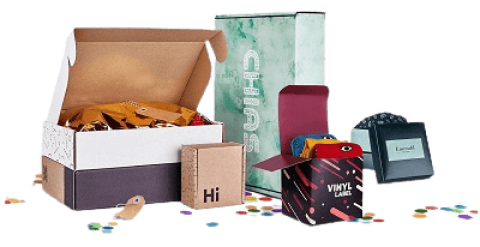
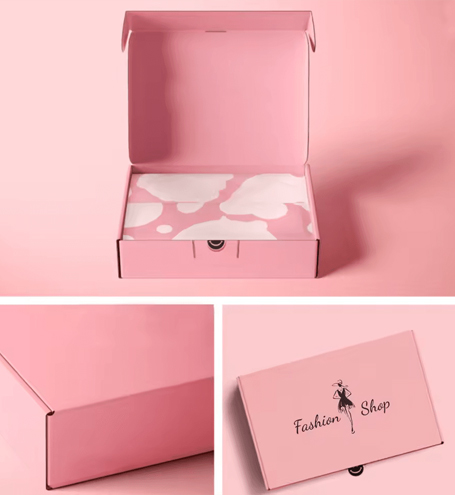
The "outside" of the box is the first impression when it comes to e-commerce brands. Subscription box companies can print their boxes with digital CMYK printing services and update the packaging monthly or quarterly without worrying too much about the costs spiraling out of control.
All three types of printing are performed based on a CMYK workflow: personalized inserts, custom tape, and branded tissue paper.
Pharmaceutical Packaging
In the pharma packaging industry, precision is key. All regulatory text, barcodes, or lot numbers and expiry dates should be legible. That precision, combined with the quality of the product that is required on retail pharmacy shelves, is achieved through CMYK color printing.
One of the other benefits of variable data printing using CMYK is also the ability of serialisation and track and trace compliance on a large scale, which is of particular importance to pharmaceutical supply chains.
Conclusion
To summarise what we've learnt, CMYK printing provides packaging on a scale that is photorealistic with a high level of detail. Moreover, the use of sustainable inks ensures that the brand's image is more environmentally responsible than in the case of traditional inks. Well, CMYK also provides a significant advantage over the traditional methods, with quicker turnaround times and reduced expenses.
Custom Design Boxes offers cutting-edge CMYK printing to brands of all sizes! Our team has a team of experts providing precision, speed, and sustainability, all in one streamlined process. To get a free quote, give us a call today at 888-385-1812 or check out our website. Your brand needs to be packaged to communicate before it can speak.
Frequently Asked Questions
We’re confident that you will love our products and service.

Abdul Waheed
With over a decade of experience in the printing and packaging industry, I’ve dedicated my career to helping brands reshape their identity with creative, sustainable, and cost-effective packaging solutions. Being the CEO of Custom Designs Boxes, my mission is simple: to balance innovation with affordability so businesses of every scale can enjoy premium packaging truly reflecting their vision. When I’m not strategizing for the next big packaging trend, you’ll find me exploring design inspirations, mentoring my team, and building lasting relationships with clients.