Table Of Content
Have you ever held a brochure that was flimsy (looking cheap) and instantly lost your desire for the brand? Or a business card that was so thick and velvety that it felt like you were interacting with something incredibly good?
All of what you feel is attributed to a single, very important technical value, GSM paper weight. Remember this as the universal standard for the thickness of paper that also determines the saturation of your ink, clarity of your design, and the strength of your packaging boxes.
A perfect combination of form and functionality is achievable by balancing the fiber density of print material with the print surface so that your marketing materials are as professional as they appear to be. In fact, the wrong choice can show color bleeding, structural failure, or a low-end feel that unintentionally drives away potential customers.
Let’s break it down - no fluff, no jargon overload. Just a smooth, slightly funky walkthrough of everything you need to know about GSM paper weight.
What Does GSM Mean?
When you get into the details of stationery or packaging, the first acronym you come across is GSM. So, what does GSM mean? Well, it stands for grams per square meter. And it is defined as “a measurement that tells you how much a sheet of paper weighs based on its size.” The reason why this system is the global standard is due to its accuracy.
When the professionals talk about the GSM in paper weight, they talk about the real material of the fibers. The more numbers it has, the thinner and the lighter the sheet, and generally, the more opaque.
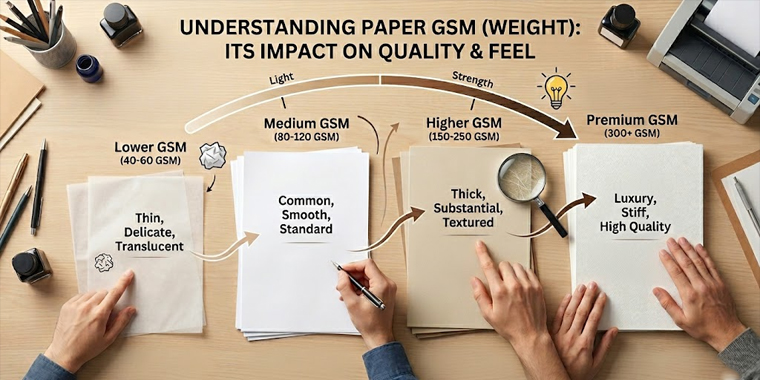
Light GSM = soft, flexible, everyday use
High GSM = thick, premium, sturdy
Still wondering what is GSMin paper? When people evaluate GSM, they typically try to determine the thickness of the paper, whether it is strong or weak, and when it is appropriate for printing or packaging. Because GSM on paper is a universal, defined measurement that is independent of sheet size, designers and printers may easily understand that a 300 GSM sheet is always heavier than a 200 GSM sheet.
In terms of action and use per GSM measurement in paper:
- A newspaper → low GSM
- A flyer → medium GSM
- A luxury business card → high GSM
How Much Does a Piece of Paper Weigh?
Let's use A4 paper, which is a typical office size, as an example. Since an A4 sheet is roughly 1/16th of a square meter:
- 80 GSM A4 paper ≈ 5 grams
- 100 GSM A4 paper ≈ 6.25 grams
- 300 GSM A4 paper ≈ 18–19 grams
The next time you're holding a sheet, you're actually only holding a few grams, but that little difference can completely alter the texture and appearance.
Types of GSM Paper and Their Uses
Here is your GSM paper weight guide:
|
GSM Range |
Feel | Common Use |
| 35–55 GSM | Ultra-thin | Newspapers |
| 70–100 GSM | Standard | Office printing |
| 120–170 GSM | Smooth & solid | Flyers, posters |
| 200–300 GSM | Thick | Brochures, covers |
| 300–400 GSM | Extra thick | Business cards |
| 400+ GSM | Board-like | Packaging |
Now, let’s get into details…
Lightweight Paper
Lightweight paper typically falls within the 35–90 GSM range. Their defining traits are flexibility and a high page count potential (ability to support a greater number of pages without adding bulk), which makes them suitable for huge print runs.
Since they are thinner, they provide a lower level of opacity. This is why you can see a ghosting effect. It is where written texts or printed graphics can be seen through the other side.
The best part is that it is the standard of the industry in high-volume/low-cost distribution, as well as where the postage and portability are the key issues of the business. And yes, it can be your everyday office hero for:
- Documents
- Photocopying
- Letterheads
Medium-Weight Paper
The middle range of paper, 100-170 GSM, is what most commercial marketing picks. It provides a big improvement in quality and durability relative to a typical office bond. Moreover, this weight is heavy enough, offering a professional appearance + good texture + a superior level of opaqueness that avoids ink show-through + strength to take high coverage of ink saturation without bending.
Absolutely robust and reliable!
Considering how it feels more “put together”, use medium-weight paper for:
- Flyers
- Posters
- Internal marketing
Heavyweight Paper
Now we’re talking premium!
Cardstock or heavyweight paper starting from 200 GSM and extending to very high GSM, these materials give the rigidity required to support the items that should be self-supporting or withstand repetitive usage. Such as:
- Brochures
- Magazine covers
- Invitations boxes
- Business cards
- Custom Postcards
Additionally, these materials provide the satisfying snap and tactile presence that characterize premium, fashionable brands due to their significant weight and sumptuous feel.
400+ GSM
This deserves a separate mention, as here you come to a heavy-duty territory. This thick material is basically used for making first impressions unforgettable. Its application includes:
- Personalized packaging
- Premium rigid boxes
- Luxury gift boxes
GSM vs LBS Paper Weight
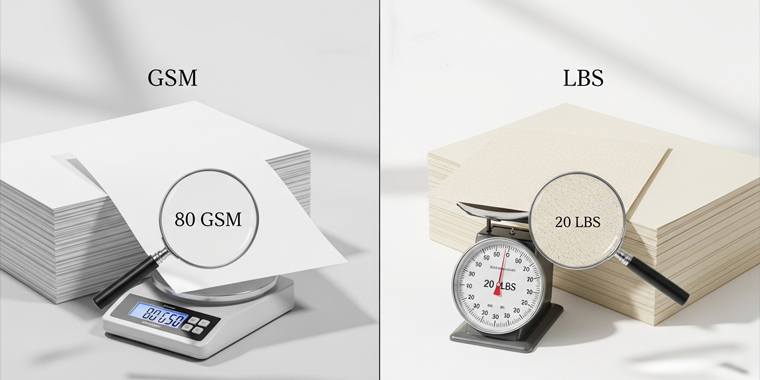
The GSM vs. LBS paper weight debate has confused the printing industry. To the world, it is generally GSM; however, in the United States, there is a tendency to use the weight based on pounds (lbs).
The major problem with the lbs system is that the system relies on the size of the category of paper. As an example, 100lb paper "Text" would be a lot thinner than 100lb paper "Cover" paper. This inconsistency may cause costly inaccuracies in the ordering process.
GSM is always more precise since it does not change with the type of paper. You normally use certain multipliers to convert, i.e., to convert lbs (Cover) to GSM, you would multiply it by 2.704. Most professionals, however, find it difficult to compute the weight of the GSM paper manually.
Instead, they use a GSM paper weight chart that has been pre-calculated beforehand to make sure that they are obtaining the exact weight of paper that they need in order to complete their project.
The Selection of the appropriate GSM Paper
Determinant of the Purpose:
Is this a flyer that should be disposed of or a gift jewelry box? The items that stay for long lean towards the heavier range of the GSM paper weight spectrum. Structural strength is needed in packaging, but in a letterhead, thinness is required to fold up in an envelope.
Budget Analysis:
Generally, the increase in GSM not only affects material cost, but the shipping cost as well. Because how much does a piece of paper weighs matters to the overall weight of your shipment. Moreover, you have to use a balance between the premium feel and the logistical reality of your distribution.
Take into Account Finish:
Coated papers (glossy or not) tend to be lighter than the uncoated ones of the same GSM. The reason is that the coating condenses the fibers. In case you prefer the chunky feel, an uncoated 250 GSM will feel significantly thicker than a gloss-coated 250 GSM would.
Determine Durability:
When your product is going to be used a lot (such as the menu of a restaurant or a shipping box), there is no bargaining when it comes to the high GSM for packaging materials. You require a material that does not tear away and crushes corners to preserve the integrity of your brand.
Paper Weight Guide for Printing
Choosing the right GSM directly impacts print quality and durability.
GSM for Digital Printing:
- Optimal GSM: 90–300
- Best for: Flyers, booklets, short-run prints
- Handles lighter to medium-weight papers efficiently
GSM for Offset Printing:
- Optimal GSM: 120–350
- Best for: Bulk prints, magazines, premium brochures
- Prefers consistent, heavier paper for sharp results
Read More: Offset VS Digital Printing – What Works Best for You in 2026
Conclusion
The art of mastering GSM paper weight goes beyond the technical requirement; it is a geometrical power of design that determines how your brand is felt at the very first touch.
If you want the authority of high-end, rigidity of premium packaging, or you want the smooth, utilitarian functionality of a new brochure, every gram that you add to your material changes the story of your brand. Through this extensive GSM paper weight guide, you no longer have to guess, but you are creating a conscious sensorial experience, which conveys quality, consistency, and precision.
Need custom packaging or print materials that deliver both style and substance? Contact Custom Design Boxes at 888-385-1812 today and talk about the next project.
Frequently Asked Questions
We’re confident that you will love our products and service.

Abdul Waheed
With over a decade of experience in the printing and packaging industry, I’ve dedicated my career to helping brands reshape their identity with creative, sustainable, and cost-effective packaging solutions. Being the CEO of Custom Designs Boxes, my mission is simple: to balance innovation with affordability so businesses of every scale can enjoy premium packaging truly reflecting their vision. When I’m not strategizing for the next big packaging trend, you’ll find me exploring design inspirations, mentoring my team, and building lasting relationships with clients.