Table Of Content
You are reading a magazine and notice extra-smooth and glossy pages. The colours appear bright and intense. Yes, it's the marvel of coated paper. Such material comes coated with a layer that fills the small spaces between the paper fibres, giving a uniform and slick surface that does not absorb ink. It's best used in custom product packaging, label printing, publishing, food wrapping, and brochures.
It plays a huge role in making products look more professional, durable, and visually appealing. However, what precisely is coated paper? What kinds are there? Most significantly, is it possible to recycle coated paper? Let's break down all the information you require.
What Makes Paper "Coated"?
Paper that has a coating applied to it to strengthen its surface qualities is known as coated paper. The finish improves print quality, color vibrancy, longevity, and resistance to grease, fingerprints, and moisture by producing a smoother, more consistent texture. According to the intended purpose, the coating may be made of silicone, polymers, minerals, clay, resins, polyethylene, or other specialty materials.
Instead of soaking deeply into the fibers, ink sits closer to the top due to the less porous surface. This results in cleaner text, higher-quality graphics, and a more honed overall look.
Coated vs Uncoated Paper | A Quick Comparison
It is one of the most commonly asked questions in printing & retail packaging. And the answer is:
- Coated: Paper with a particular finish on it is coated paper. Ink stays on top, and colors are always striking and bright. Moreover, it is best used for photos, magazines, product packaging, and situations where the product's visual quality is important.
- Uncoated: Uncoated paper comes with an open surface, consisting of fibers that can be picked up by the fingers. Ink soaks in, giving subtle and muted designs. You can even write on it. Uncoated options are suitable for print office papers, notebooks, envelopes, and letterheads.
Fact: The global coated paper market is expected to see $43.6 billion in sales by 2029, as demand for coated papers in packaging and print media keeps increasing due to their superior printability and versatility. (Source: smithers.com)
Types of Coated Paper
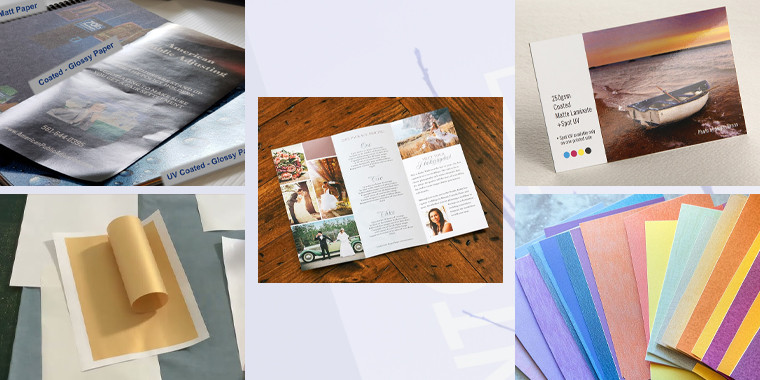
There is no single variety of coated paper. In fact, there are many, and each has a different function.
| Type | Coating Material | Key Use | Finish |
| Matte Coated | Mineral-based | Books, brochures | Flat, no shine |
| Clay Coated | Clay minerals | Magazines, catalogs | Smooth, bright |
| Kaolin Coated | Kaolin clay | High-quality printing | Bright, even |
| PE Coated | Polyethylene | Food packaging, cups | Waterproof |
| Resin Coated | Plastic resin | Photo printing | Glossy, stiff |
| Poly Coated | Polymer blend | Freezer, outdoor labels | Moisture-resistant |
| Silicone Coated | Silicone | Baking paper, liners | Non-stick |
| Silk Coated | Mineral blend | Business cards, flyers | Soft sheen |
| Inkjet Coated | Inkjet-specific | Inkjet photo prints | Varies |
1. Matte Coated Paper
This is simply a low-reflective paper with a flat appearance that is incredibly smooth to touch. Matte paper does not reflect light, which makes it easier to read even in flashes.
In a practical world, it is very popular for brochures, books, and packaging where readability is more important than a glaring impression. Matte coated paper is preferred by many high-end skincare and cosmetic companies because it conveys quality without being ostentatious.
2. Clay Coated Paper
A paper coated with a mineral clay improves smoothness, brightness, and print performance, making it one of the most used papers in commercial printing. The best part is its superior image reproduction and amazing ink holdout.
Need to print magazines, catalogs, or food packages? This is your solution that also happens to be cost-saving.
3. Kaolin Coated Paper
Kaolin-coated paper is a particular kind of clay-coated paper (Kaolin is a white clay mineral). It is purified and combined with a binder and applied to the selected paper surface for highly printable and accurate color reproduction. The kaolin does not add artificial whiteners to the paper, but rather imparts a natural shine. You can find its use in educational materials.
4. PE Coated Paper
PE-coated paper is the same as polyethylene paper. Here, a thin layer of plastic (polyethylene) is imposed on the paper surface. This makes the paper water- and grease-proof. Further, it is widely used for food packaging.
Examples include disposable coffee cups, fast food wrappers, frozen food bags, and juice cartons. Why? Because the water-resistant plastic layer prevents liquids from seeping through.
5. Resin Coated Paper
Resin-coated paper is paper that has a plastic resin film on either side. Mostly used in photo printing, the resin helps to protect the paper from chemicals during photo processing. It also promotes quicker drying of the paper and stiffens it up. The top benefits are improved strength and incredible moisture protection.
6. Poly Coated Paper
Poly-coated paper is similar to PE-coated paper with different polymers. It is intended for high-moisture areas and is commonly used in cold storage labels and outdoor tags. The poly layer is tear, moisture, and temperature-resistant.
Read More: Why Silicone-Coated Cardboard is Revolutionizing Packaging Solutions
7. Silicone Coated Paper
Paper with a silicone layer on one or both sides provides a non-stick surface used for baking paper, label release liners, and medical packaging. From offering excellent release properties to unmatched heat- and chemical resistance, this option stands out. In its making, the silicone does not enter the paper and remains on the surface. It helps create a permanent bond and smooth surface performance.
8. Silk Coated Paper
The silk coated paper is a medium between matte and gloss finishes. On the one hand, it has a light sheen but is not shiny enough. On the other hand, the surface is soft and smooth, making it appropriate for business cards, flyers, and high-quality packages. Printed products with a silk finish have a classy and refined appearance without the shine of a glossy paper.
9. Inkjet Coated Paper
Inkjet-coated paper is specifically designed to be used in inkjet printers. The coating is purposely created to absorb inks faster. This will minimize smearing and bleeding. Moreover, it yields high-resolution prints while maintaining true color accuracy. This is commonly used for photo papers, presentation sheets, and large-format prints.
10. Heavyweight Coated Paper
A heavyweight coated paper boasts greater rigidity, thickness, and strength than a standard coated paper. Anything over 170 GSM is considered to be heavyweight. The added weight will provide a strong feel to the printed material. Besides, it is used in the making of business cards, invites, book covers, greeting cards, and product packaging.
Can Coated Paper Be Recycled?
Can paper that has a coating on it be reused? In many cases, yes. Typically, mineral-coated papers, such as clay or kaolin, can be recycled. The coating melts when it goes into the pulping tanks of paper recycling. There are no problems with these papers in most curbside recycling programs. But the papers with plastic or resin layers are more difficult to recycle. After all, the plastic layer is not easily soluble. This may lead to pollution and sustainability issues.
How to Recycle Coated Paper Milk Cartons
One of the most popular products made from recycled coated paper is milk cartons. Here's how the process typically works:
- Step 1: Make sure there is no liquid left in the carton by emptying it.
- Step 2: To avoid contamination, immediately rinse away any remaining milk.
- Step 3: In order to conserve space during collection, some municipalities favor flattened boxes.
- Step 4: Put it in the designated recycling container. You must adhere to the guidelines provided by your local recycling program.
Paper fibers are cut apart, plastic coatings are taken out, and recovered fibers are processed to create new paper goods at the recycling facility, such as:
- Tissue paper
- Cardboard products
- Paper towels
- Building materials
- New packaging products
Conclusion
Coated paper is used all over the world. It's in the food you consume, the boxes you purchase your products in, and the print you're reading each day. There are various types that you should know so that you can select the one that is suitable for printing, packaging, or any project. Whether it's the waterproofing of PE-coated paper or the smooth application of silk-coated paper, there's a reason.
Since it's a matter of knowing what to use, it saves time and waste and creates better results. We at Custom Design Boxes have access to various paper stocks with different coatings to produce packaging that will look sharp and perform well. We can assist you in finding the coating or finishes that are food-safe, matte, or heavy-duty for the structure you are looking for.
Give us a call today at 888-385-1812 to talk about packaging solutions. We know the material and finish required for your next project and are prepared to offer help.
Frequently Asked Questions
We’re confident that you will love our products and service.

Abdul Waheed
With over a decade of experience in the printing and packaging industry, I’ve dedicated my career to helping brands reshape their identity with creative, sustainable, and cost-effective packaging solutions. Being the CEO of Custom Designs Boxes, my mission is simple: to balance innovation with affordability so businesses of every scale can enjoy premium packaging truly reflecting their vision. When I’m not strategizing for the next big packaging trend, you’ll find me exploring design inspirations, mentoring my team, and building lasting relationships with clients.