Table Of Content
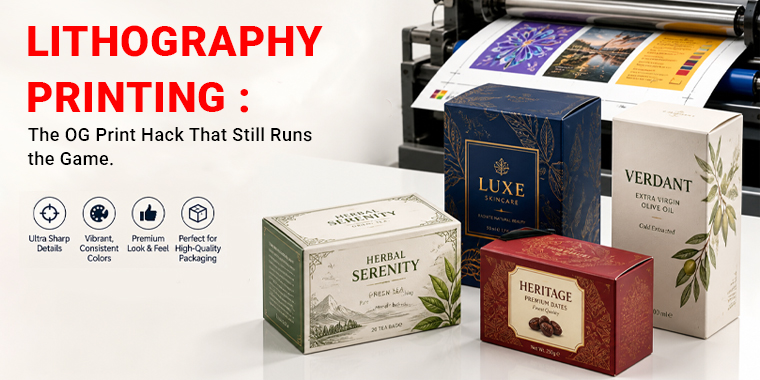
If printing had a hall of fame, lithography printing would be sitting front row, unapologetically iconic.
Lithography printing has matured like a pro, maintaining its roots while adjusting to current technology. This method is used in vintage art posters, magazines, and brochures as well as in high-speed packaging. In fact, it is the prime choice for businesses that can not compromise on accuracy, consistency, and scalability. After all, lithography prints images with clear details and in dynamic colors.
But what is it, how does it function, and why is it still so prevalent? Let's break it in a way that makes sense.
The Lithography Printing: What Is It?
Lithography printing is a “flat surface printing technology”; the principle underpinning the technique is the fact that oil does not mix with water. In simpler words, this amazing chemical resistance is tactically used to keep image areas (oil) separated from non-image (water) areas. Further, it involves transferring ink onto a material, usually paper or a packaging material, using a chemically treated plate.
The examples of lithography printing are infinite in our daily lives (besides custom display boxes), including:
- Product packaging boxes
- Magazines and catalogs
- Brochures and business cards.
- Labels and stickers
- Advertisements and promotional documents.
History of Lithography Printing
Germans invented lithography, which dates back to 1796. Specifically, Alois Senefelder introduced this technique, where limestone slabs were used. Moving forward to the 1800s, it became popular and was preferred for art prints and maps - thanks to its efficiency and capacity to recreate fine images.
In the early 1900s, lithography developed into offset printing, which revolutionized commercial printing. Well, this development allowed high volumes to be produced with stable quality.
In recent times, digital and even lithography 3D printing variations exist. Instead of limestone, metal plates and automated presses are used now. It also demonstrates the flexibility of this technology. Most surprisingly, it is the best pick for sustainable packaging as it is prized as an eco-safe pick.
Key Benefits of Lithography Printing
Lithography is still the leading commercial printing process due to several reasons:
- Excellent print quality (bold colors and clear images)
- Cost-saving (especially when it comes to bulk orders)
- Color consistency and uniformity (even in large runs)
- Works on various and plenty of materials (be it rigid, paperboard, or cardboard)
- Provides a professional finish (much needed for branding and luxury packaging)
Step-by-Step Process (How It Actually Works)
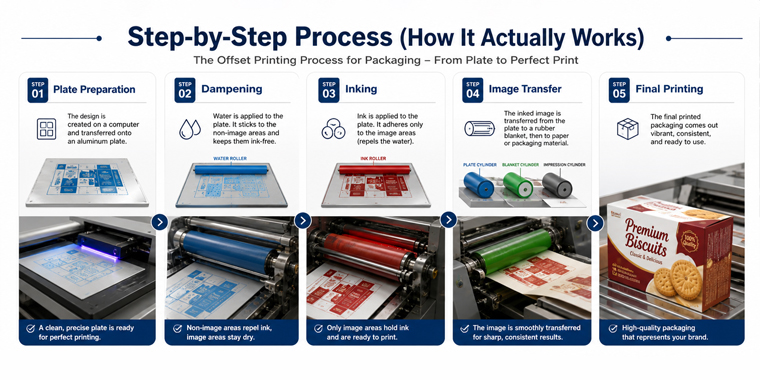
Awareness of the lithography printing process makes businesses understand why this technique has continued to give good quality and professional outcomes. Remember, all the stages are important in ensuring accuracy in precision, color, and efficiency.
Step 01: Plate Preparation
The procedure starts with the design or artwork being transferred to a printing plate that is usually made of aluminum. This plate is subjected to a chemical process that allows the image regions to receive ink and the non-image areas to reject ink (attract water).
Step 02: Dampening
In this phase, water is applied to the plate, and it is only held by non-image areas. This action is essential since it will make sure that ink does not remain in the wrong places. Water and ink should be balanced so as to prevent any problems that may arise, such as smudging or imbalanced printing.
Step 03: Inking
Oil-based ink is then rolled onto the plate after dampening. The ink is only sticking to the image parts due to the chemical separation that has been generated previously.
Step 04: Image Transfer
Lithography does not print the image onto the paper but uses a rubber blanket in between. The plate is first inked, pressed on this blanket, and then used to print on the paper. Why? The plate wear is lessened and is more predictable.
Step 05: Final Printing
At this last step, the rubber blanket is transferred to the paper, cardboard, or another material (your choice) of retail boxes. The ink is then pressed to make sure that it sticks correctly to produce a clean and accurate print.
Types of Lithography Printing
Lithography has developed into various forms, which are customized to suit certain industrial, commercial, and technological requirements. The knowledge acquired about these types assists businesses in selecting the appropriate approach according to the volume, quality expectations, and usage.
| Printing Type | Overview | Key Benefits | Best For |
| Offset Lithography | Uses plates and a rubber blanket to transfer ink for consistent, high-volume printing. | High quality, cost-effective in bulk, material versatility, consistent branding | Magazines, brochures, large-scale orders, and gift packaging |
| Digital Lithography | Combines lithographic quality with digital flexibility, often without plates. | Fast setup, quick turnaround, customization, ideal for short runs | Personalized prints on e-commerce packaging, prototypes, and limited editions |
| Lithography 3D Printing | Uses light to cure resin layer by layer, creating precise 3D objects. | High precision, smooth finish, complex designs | Healthcare, engineering, and small, detailed components |
Read More: Everything You Need to Know About Offset Printing for Professional Results
Lithography vs Screen Printing
Screen printing and lithography are two widely used yet distinct methods, each with its own advantages.
- Lithography is perfect for paper-based products and packaging because it uses a flat surface method that produces sharp resolution and great detail. Additionally, it is more effective in large-scale production, when uniformity and speed are crucial.
- In contrast, screen printing applies thicker layers of ink for a dramatic and textured finish using mesh screens and stencils. It is renowned for creating vivid, striking designs and works well on a range of surfaces, including fabric, glass, and plastic.
In short, screen printing emphasizes bold impact and visual strength, whereas lithography is all about precision and fine detail.
Conclusion
The lithography printing technique is still the backbone of modern printing, and is scalable, efficient, and superior in quality. Through the extensive development of the evolution to the current applications, this method still keeps up with the dynamics of changing businesses without losing its reputation for accuracy and consistency. Surely, it is a strong and trusted solution for companies that care about branding, packaging, and corporate image.
When quality, consistency, and impact are important to your brand, then lithography printing is not a choice; it is a no-brainer decision. Custom Designs Boxes is equipped with skilled designers, trained machine operators, and superlative tools to offer the best quality litho printing - be it a mylar bag or retail branded box. For further details, contact us at 888-385-1812.
Frequently Asked Questions
We’re confident that you will love our products and service.

Abdul Waheed
With over a decade of experience in the printing and packaging industry, I’ve dedicated my career to helping brands reshape their identity with creative, sustainable, and cost-effective packaging solutions. Being the CEO of Custom Designs Boxes, my mission is simple: to balance innovation with affordability so businesses of every scale can enjoy premium packaging truly reflecting their vision. When I’m not strategizing for the next big packaging trend, you’ll find me exploring design inspirations, mentoring my team, and building lasting relationships with clients.