Table Of Content
Plastic pollution is no longer a far-off environmental concept; it is a day-to-day experience in terms of the oceans, wildlife, food systems, and human health. Both businesses and consumers are seeking alternatives that are more waste-minimizing without losing performance.
Biodegradable packaging can be brought into the discussion as a potential solution. However, is biodegradable packaging better, or is it an overrated trend?
Well, the biodegradable packaging can help considerably decrease the negative impact on the environment, provided that it is properly used, obtained, and disposed of.
Bonus: Remember, not every biodegradable food packaging material works the same, and misconceptions regarding compostable and biodegradable food packaging often result in unrealistic expectations.
The International Packaging Waste Crisis
Conventional types of plastic packaging, particularly food and beverage containers, can require hundreds of years to decompose. And when it does, it breaks down into millions of tiny fragments, known as microplastics. This is exactly what pollutes the ecosystems and food chains.
Fact: It is estimated that the amount of plastic waste generated in the world is more than 400 million tons each year, of which packaging contributes almost half.
With stricter controls and the emergence of brands that are eco-aware and cautious, there is pressure on brands to reconsider their packaging approach. Sustainable packaging is not a new phenomenon; it is the reaction to the environmental pressure, new rules, and consumers changing their values.
Biodegradable Packaging: What Is It?
Biodegradable packaging is the term used to denote the materials that are capable of breaking down naturally in the form of water, carbon dioxide, and biomass under the influence of microorganisms, e.g., bacteria and fungi. In other words, it is a packaging that doesn’t overstay its welcome on the planet. And yes, this goes beyond the typical supermarket bag.
The following differences are important to understand, particularly in the cases of biodegradable vs compostable food packaging, because their abuse may restrict the environmental gains.
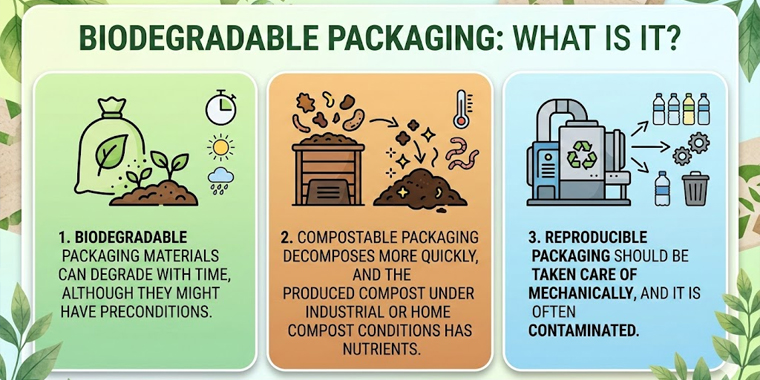
- Biodegradable packaging materials can degrade with time, although they might have preconditions.
- Compostable packaging decomposes more quickly, and the produced compost under industrial or home compost conditions has nutrients.
- Reproducible packaging should be taken care of mechanically, and it is often contaminated.
Common Materials Used in Bio Food Packaging
The materials for retail packaging are made of renewable sources, which include:
- Corn starch produces PLA (polylactic acid)
- Bagasse (sugarcane fiber)
- Starch-based blends
- Cellulose films
- Coated paper that is biodegradable
The Mechanism
Biodegradation is not a magic, but a biological process.
The material is used to provide food to the microorganisms, which degrade chains of molecules into natural compounds. Nevertheless, this process is only effective when there is an environment that favors the activity of microbes.
To biodegrade, the following conditions are important:
- Adequate moisture
- Presence of oxygen
- Warm temperatures
- Bio-aggressive microbial communities.
In their absence, even biodegradable packaging bags can act as normal plastic in the landfills. You can take an example of biodegradable dog food packaging, biodegradable sachet packaging, etc.
Applications in the Real World at an Industrial Level
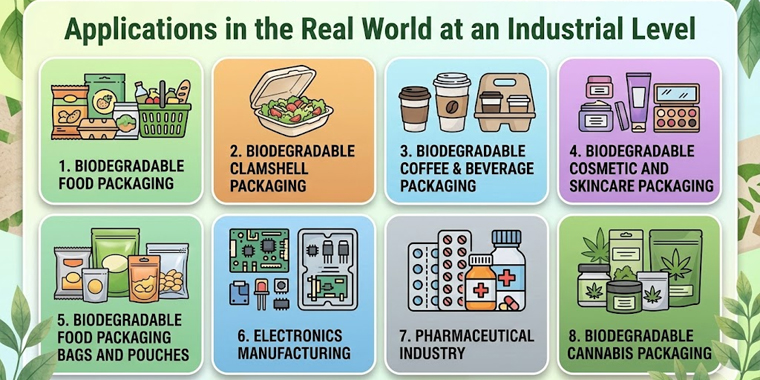
The following are some of the most well-liked green packaging designs that are reshaping the market:
1. Biodegradable food packaging:
Think of biodegradable sandwich packaging and biodegradable bakery packaging, which keep your food fresh without harming the environment, and are ideal for everything from hamburgers to tacos.
On the one hand, it is beneficial for mass packaging of ready-to-eat meals and fresh produce. On the other hand, it is food-safe and sturdy enough to ensure the protection of packed items.
2. Biodegradable clamshell packaging:
Those handy salad or takeaway containers? There is now a biodegradable twin of them, and it decomposes naturally.
3. Biodegradable coffee & Beverage packaging:
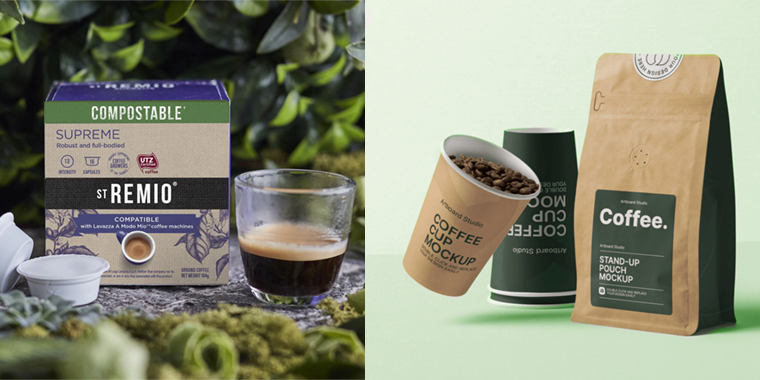
Eco-love is also due to your morning brew. With this, every drink, from beans to grinds, will be guilt-free. Its composition allows the packaging to organically return to the ground while maintaining the fresh scent. Moreover, it is loved for being heat-resistant.
Read More: Biodegradable VS. Recyclable Coffee Packaging: What’s the Greener Choice
4. Biodegradable cosmetic and skincare packaging:
These days, lip balms, lotions, serums, and more come in packaging that won't end up in landfills. The result is strengthened branding and “green” objectives that can help win consumer trust.
5. Biodegradable food packaging bags and pouches:
Perfect for pet treats, coffee grounds, and munchies, this is best used as pet food packaging.
6. Electronics Manufacturing:
Utilizing environmentally friendly materials lessens dependency on traditional plastics while guaranteeing stress absorption. Moreover, sustainable solutions combine economy and responsibility in contemporary packaging, protecting delicate electronics while simultaneously reducing environmental effects.
7. Pharmaceutical Industry
Unit-dose medication and supplement packaging is becoming more and more biodegradable in the pharmaceutical sector. By reducing plastic trash, this change not only guarantees regulatory compliance but also lessens its impact on the environment.
8. Biodegradable cannabis packaging:
Yes, even in the cannabis industry, sustainability is chic. It lessens your environmental impact while preserving the freshness of your items. Eco-friendly packaging has become the norm for anything from edibles to pre-rolls.
Biodegradable packaging materials come in a variety of forms, textures, and designs, ranging from films and paper wraps to cornstarch-based trays, PLA plastics, and plant-fiber composites.
Advantages of Eco-Friendly Packaging
Here’s where the magic happens. Choosing biodegradable packaging isn’t just trendy—it’s smart. Let’s break down the major perks:
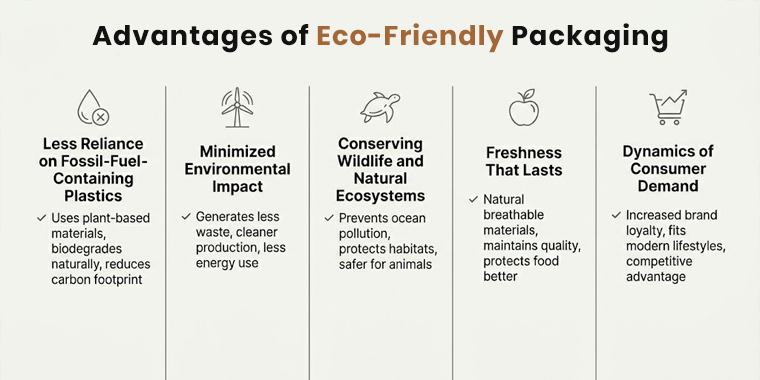
Less Reliance on Fossil-Fuel-Containing Plastics
Renewable resources that are mostly used to produce biodegradable packaging materials include corn starch, sugarcane bagasse, and plant fibers. This will lower the use of petroleum-based plastics, which will assist in conserving non-renewable resources. Moreover, in the long run, this transition would reduce the emission of greenhouse gases.
Minimized Environmental Impact
When the biodegradable food packaging is disposed of in the appropriate environment, it decomposes to form natural compounds such as water, carbon dioxide, and biomass. It does not last centuries and emits harmful microplastics as traditional plastics do.
Conserving Wildlife and Natural Ecosystems
Conventional plastic containers usually harm wildlife either by ingesting them or entangling them. Biodegradable packaging bags and pouches are made to decompose, and this will minimize the risk to fish and other animals on land. Yes, these materials can be decomposed into non-toxic elements.
Freshness That Lasts
Startled? Certain biodegradable materials can preserve freshness and even increase shelf life, particularly those used in biodegradable food packaging materials. For example, biodegradable bakery packaging eliminates the need for plastic while maintaining the softness of buns and pastries.
Dynamics of Consumer Demand
The modern customer is very active and wants to consume a product that is packaged in biodegradable food materials and environmentally friendly products. Companies that use f kraft boxes would have an advantage, as they would be in touch with the concept of sustainability.
Eco Showdown: Biodegradable vs Traditional Plastic
| Category | Biodegradable Packaging | Conventional Plastic / Other Alternatives |
| Environmental Impact | Although not ideal, it has a high chance of minimizing the risk of long-term pollution, as it decomposes naturally over time | Never degenerate; traditional ones emit toxins and microplastics. |
| Life Cycle Analysis | Lower carbon emissions, reduced energy use, better end-of-life outcomes | Often higher emissions and energy consumption, poor end-of-life management |
| Caution | Benefits can be negated by improper disposal | Environmental damage is almost guaranteed, regardless of disposal practices |
Biodegradable and Compostable Packaging
Compostable is faster to break down, and it must be in adequate composting facilities. Biodegradable alternatives are more adaptable and unpredictable.
Challenges & Considerations
Naturally, nothing is flawless. Among the difficulties that companies have when using biodegradable packaging are:
- Cost: Compared to conventional plastic, biodegradable materials may be more expensive. However, this is frequently offset by the marketing and sustainability benefits.
- Durability: Liquids and fatty meals require cautious selection because not all biodegradable materials are waterproof.
- Composting Access: A package may not decompose in your lawn just because it is biodegradable. Usually, industrial composting systems are better at handling this.
So… Biodegradable Packaging: Is It Better?
The honest answer? Yes—when used correctly. Cardboard packaging is a potent instrument for lessening the harm to the environment, improving brand loyalty, and satisfying regulatory demands. It is most effective, however, in combination with:
- Effective disposal facilities.
- Clear consumer education
- Accountable source of materials
The effectiveness will keep on improving as innovation in material science and waste management occurs in the future.
Conclusion
Sustainable packaging is not perfect; it is about improvements. Moreover, it is all about staying informed, selecting the materials that are checked, and cooperating with informed suppliers.
In case your brand is willing to take significant sustainability actions, biodegradable packaging is a good place to begin, and Custom Design Boxes is the one that is here to help you (step by step).

Abdul Waheed
With over a decade of experience in the printing and packaging industry, I’ve dedicated my career to helping brands reshape their identity with creative, sustainable, and cost-effective packaging solutions. Being the CEO of Custom Designs Boxes, my mission is simple: to balance innovation with affordability so businesses of every scale can enjoy premium packaging truly reflecting their vision. When I’m not strategizing for the next big packaging trend, you’ll find me exploring design inspirations, mentoring my team, and building lasting relationships with clients.